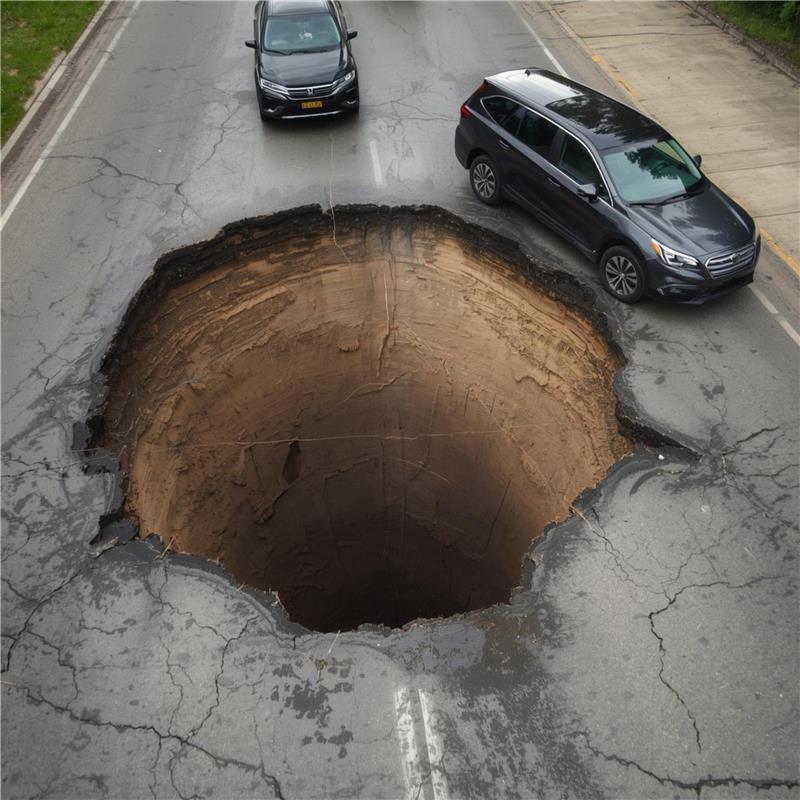
Sinkholes have featured in the news more frequently in recent months, often disrupting roads, utilities and surrounding infrastructure. While these events can appear sudden, sinkholes are a well-understood geotechnical phenomenon. Understanding how and why they occur is critical for managing risk in complex infrastructure environments.
A sinkhole is a depression or collapse of the ground surface caused by the loss of subsurface support. This typically occurs when underlying materials are dissolved, eroded or displaced, forming voids that the overlying ground cannot bridge. Sinkholes vary significantly in size and impact, ranging from minor localised subsidence to large-scale collapses affecting transport corridors and buried services.
Sinkholes are most commonly associated with geological settings containing soluble rock such as limestone, gypsum or dolomite. Groundwater movement can dissolve these materials over time, progressively forming subsurface cavities. Collapse occurs when the structural capacity of the overlying soil or rock is exceeded.
In developed environments, sinkhole formation is often influenced or accelerated by human activity. Excavation, dewatering, changes in surface water drainage, altered groundwater regimes, and additional loading from structures can disturb subsurface equilibrium. Leaking or failed underground services frequently contribute by washing soil into voids or along service alignments.
As a result, sinkholes typically arise from a combination of natural ground conditions and external influences rather than a single cause. For infrastructure assets, this interaction is particularly important, as linear networks such as roads, rail and utilities are sensitive to even small changes in subsurface conditions.
While the terms are sometimes used interchangeably, sinkholes and surface holes have different underlying mechanisms. Sinkholes generally originate from deeper subsurface voids linked to geological or groundwater processes. Surface holes, by contrast, are usually shallow failures associated with near-surface issues such as trench collapse, service leakage or poorly compacted fill.
Surface holes tend to be localised, whereas sinkholes may extend deeper and pose broader risks to adjacent infrastructure.
Although sinkholes cannot always be prevented, their likelihood and impact can often be reduced. Effective mitigation relies on appropriate ground investigation, informed foundation design, controlled drainage, and proactive management of groundwater and buried services. In higher-risk areas, monitoring ground movement and asset condition can provide early warning of developing issues.
When a sinkhole occurs, immediate actions focus on safety and asset protection. Affected areas are secured, and the extent of ground loss is assessed through targeted investigation. Remediation typically involves stabilising voids using engineered fill or grouting, repairing damaged assets, and addressing contributing factors to reduce the risk of recurrence.
Sinkholes represent a complex interaction between geology, groundwater and human activity. While they can present significant challenges for infrastructure owners and operators, informed investigation, design and monitoring enable risks to be identified early and managed effectively.
For more insights on infrastructure risk, investigation and design, get in contact with our team.